
←Blog
/
Cap Rate Compression Is Back: Why 2H 2026 Is the Window to Refinance Stabilized Assets and Harvest Tax-Free Equity
Industrial cap rates are compressing toward 4.85%. See how owners of stabilized assets can harvest tax-free equity via cash-out refinance in 2H 2026.
For three years, the phrase "commercial real estate refinancing" has carried a whiff of dread. The 2023–2024 maturity wall, distressed workouts, and cash-in refinances where owners had to write a check just to keep their buildings — that was the story. It was a defensive story.
That story is ending. A different one is beginning, and the owners who recognize the shift first will capture the most value from it.
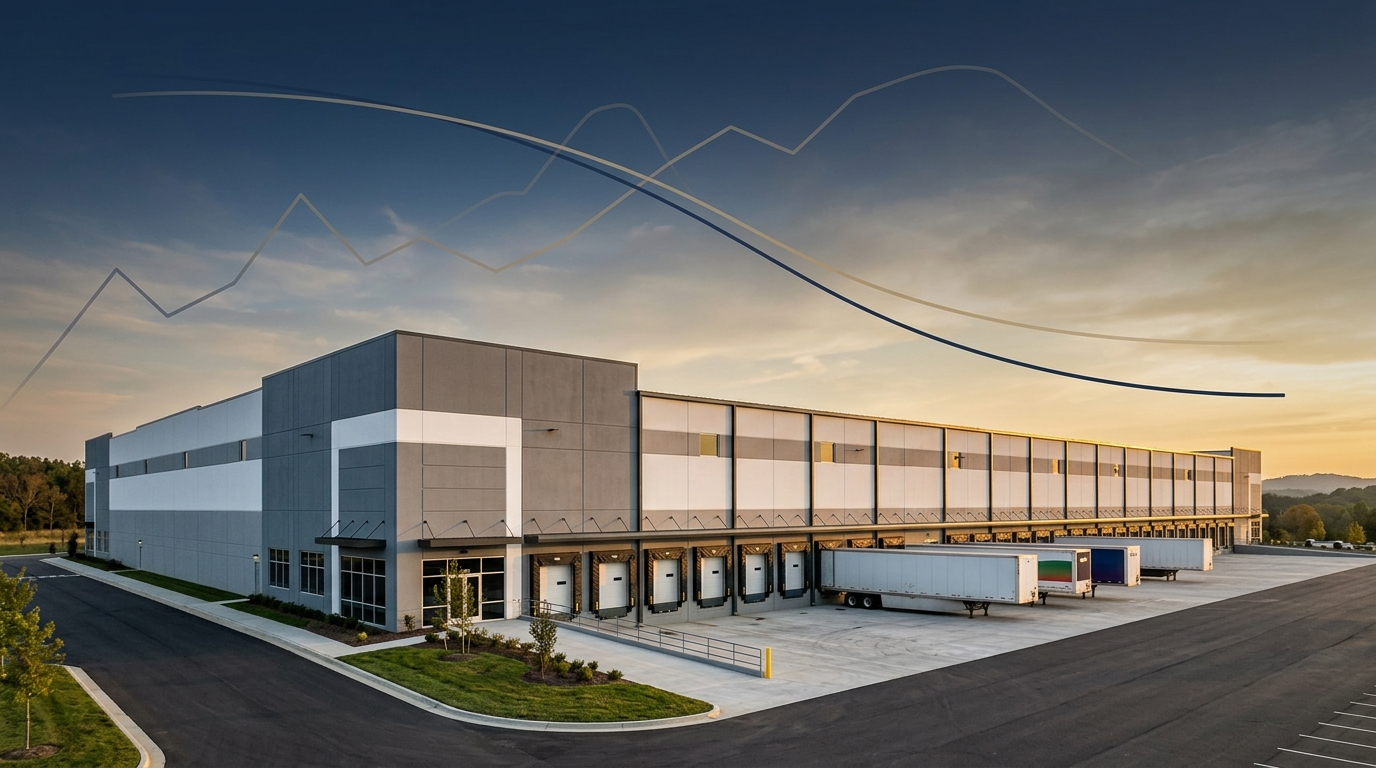
Industrial cap rates are compressing again — forecast to move from a 2023 peak of 5.35% back toward roughly 4.85% by late 2026, with some models pointing to 4.75% in 2027. For owners of stabilized, income-producing assets, that compression is quietly rebuilding equity on the balance sheet. And in the second half of 2026, a specific, time-bound opportunity is opening: the chance to convert that equity into tax-free cash through a cash-out refinance — as a value-creation move, not a distress move.
This is a playbook for high-net-worth owners, family offices, and private equity sponsors who hold quality assets and want to put idle equity back to work. Here is why the window is open, how the math works, and how to execute it before conditions normalize.
A capitalization rate is simply net operating income divided by value. When cap rates fall, values rise — even if your NOI never changes. That inverse relationship is the entire engine behind this opportunity.
Here is the trajectory the market is pricing for industrial cap rates:
| Period | Industrial Cap Rate |
|---|---|
| 2023 peak | 5.35% |
| Current (2026) | ~5.10% |
| Late 2026 (forecast) | 4.85% |
| 2027 (forecast) | 4.75% |
A 50-basis-point compression sounds small. It is not. Consider a stabilized asset generating $1 million in NOI:
That is nearly $1.9 million in value created — with no new leasing, no capital improvements, no repositioning. The building did nothing. The market re-rated the income. This is why 50 bps of cap rate compression in 2026 can generate more than a dollar of equity for every dollar of NOI.
For owners who bought or last refinanced during the 2022–2024 rate spike, this is meaningful. You have likely been sitting on a conservatively leveraged asset — 40–50% loan-to-value — precisely because you couldn't or wouldn't refinance into punishing rates. That conservatism is about to pay off.
The distinction matters enormously, and it changes how you should think about the transaction.
A distress refinance happens because a loan is maturing and the owner has no choice. Terms are dictated to them. A value-creation refinance happens because the owner chooses to recapitalize an appreciated, cash-flowing asset to extract equity on favorable terms — and then redeploys that capital into higher-returning uses.
"The current rate environment creates a compelling refinancing window for stabilized assets. Owners who locked in higher rates during 2023–2024 can now access meaningfully lower debt costs." — industry principal, commercial real estate advisory
The fundamentals underpinning industrial values are also stabilizing, which gives lenders confidence to size loans generously. In Q1 2026, national industrial asking rents posted positive year-over-year growth for the first time since 2024, up 0.8% to $10.34 per square foot. Vacancy is stabilizing in the mid-6% to low-7% range as speculative construction has slowed to a trickle — new supply is minimal because construction financing remains hard to obtain. Net absorption rebounded to between 43 and 51 million square feet in the quarter, depending on the source. Pricing power is quietly returning to the landlord.
Stabilized, well-leased industrial is exactly the asset class lenders want on their books right now. That demand is what makes a stabilized asset refinance achievable on attractive terms today.
Here is the part that makes a cash-out refinance in CRE so powerful for wealth preservation, and it deserves a clear explanation because the tax treatment is genuinely favorable.
Cash-out refinance proceeds are not taxable income. The IRS treats the money you pull out as a loan you are obligated to repay, not as a gain. You can extract hundreds of thousands — or millions — of dollars and owe nothing on it in the year you receive it. That is the essence of tax-free equity.
Compare the two ways of monetizing an appreciated building:
If you sell:
If you cash-out refinance:
One important nuance for sophisticated owners: a cash-out refinance defers, it does not erase, the eventual tax. Your larger loan balance does not increase your taxable basis. When you eventually sell, the gain is still measured against your original basis. But paired with a hold-and-refinance strategy — or an eventual 1031 exchange, or a step-up in basis at death — many owners never pay that deferred tax at all. This is why the ultra-wealthy have long favored "buy, borrow, and hold" over "buy and sell."
If tax-free equity is the why, the interest rate environment is the when — and the timing is more delicate than headlines suggest.
The Federal Reserve has moved its policy rate down to the 3.5%–3.75% range and is projected to drift toward roughly 3.1% by the end of 2026. But the Fed has explicitly signaled a cautious, pause-heavy path — markets are pricing only one, perhaps two, additional cuts, contingent on cooling inflation.
Critically, Fed cuts do not translate one-for-one into commercial mortgage rates. Long-term CRE debt is priced off the 10-year Treasury (currently ~3.8%, expected to ease toward 3.25%–3.50%) plus a lender spread — not off the overnight rate. All-in commercial borrowing costs are expected to grind from roughly 5.75%–6.25% today toward 5.25%–5.75%. As of mid-July 2026, commercial mortgage rates were quoting from about 5.70%.
This creates a genuine "Goldilocks" window in 2H 2026:
Waiting for the "perfect" bottom is the classic mistake. If you wait until rates are unambiguously low, so will every other owner — and lender pipelines, appraisal timelines, and pricing discipline all deteriorate in a stampede. Moving during the cautious phase, ahead of the crowd, is how you lock in both a strong appraised value and a motivated lender.
Consider a real-world-style example: a 125,000-square-foot distribution warehouse, 100% leased, purchased in 2019 for $12.5 million.
| Metric | Existing Position | New Cash-Out Refinance |
|---|---|---|
| Current value | $17.0M | $17.0M |
| NOI | $1.1M | $1.1M |
| Loan balance | $7.5M | $11.05M |
| Interest rate | 4.5% | 5.75% |
| LTV | 44% | 65% |
| DSCR | 1.94x | 1.40x |
| Tax-free cash out | — | ~$3.55M |
The owner walks away with roughly $3.55 million in tax-free proceeds, still owns the building, still collects the income, and still comfortably covers debt service at a healthy 1.40x DSCR. That $3.55M can fund the down payment on a new acquisition, a partner buyout, reserve replenishment, or a distribution to investors — all without triggering a single dollar of capital gains or recapture tax.
That is value creation. The asset was appreciated and under-leveraged; the refinance simply converted trapped equity into deployable, tax-free capital.
Enthusiasm aside, you will not get whatever number you want. In 2026, lenders size loans against the lowest result of three constraints — and underwriting has tightened. Understand all three before you model your proceeds:
Loan-to-Value (LTV). For refinances, lenders lean on the fresh appraisal. Well-leased industrial can reach 70%–75%, but cash-out deals are typically capped a notch lower, around 65%–70%, because lenders view equity extraction as marginally riskier.
Debt Service Coverage Ratio (DSCR). A January 2026 underwriting memo from a major CRE lender raised the stabilized-asset minimum from 1.20x to 1.25x, with transitional deals pushed to 1.30x or higher. Strong industrial cash flow clears this easily; thinner NOI gets sized down here.
Debt Yield. NOI divided by loan amount, with a floor around 8.5%–10%. This is the lender's sanity check independent of rates and appraisal — and it is often the binding constraint on aggressive cash-out requests.
Your loan product matters too. Bank debt (roughly SOFR + 250 bps, 5–7 year terms) offers flexibility but reset risk. Life-company loans (5.75%–6.25%, 10–15 years) and CMBS (6.0%–6.5%, 10 years) lock in long-term certainty at the cost of prepayment penalties like yield maintenance or defeasance. For a hold-and-harvest strategy, long-term fixed-rate debt usually wins.
Plan for a 10-to-16-week execution timeline from preparation to closing. Starting now positions you to close inside the 2H 2026 window.
Discipline is what separates value creation from the next cycle's distress. A cash-out refinance is the wrong move if:
The goal is to recapitalize strength, not to paper over weakness.
The convergence is rare: industrial cap rates compressing, values rising, fundamentals firming, borrowing costs easing off their peak, and a tax code that lets you extract the resulting equity tax-free. For owners of stabilized assets who spent the last three years playing defense, 2H 2026 is the moment to go on offense.
But windows like this close as capital floods back in and lenders regain pricing power. The owners who move deliberately — while the Fed is still cautious and the crowd is still hesitant — will lock in the strongest appraisals and the best terms.
At SMART Investments, we help high-net-worth owners, family offices, and private equity sponsors model, structure, and execute value-creation refinances that turn appreciated assets into tax-free, deployable capital. If you own a stabilized industrial or commercial asset, now is the time to run the numbers. Schedule a confidential refinance analysis with our team — we'll map your equity position, model your tax-free proceeds, and time your execution against the rate curve. The window is open. Let's put your equity to work.
This article is for educational purposes and does not constitute tax, legal, or investment advice. Consult your CPA and financial advisor regarding your specific circumstances.