←Blog
/
The $214 Billion Asset Class Hiding in Plain Sight: Why Brookfield's $1.2B Peakstone Grab Signals Industrial Outdoor Storage's Institutional Moment
Brookfield's $1.2B Peakstone take-private confirms industrial outdoor storage as institutional. Inside IOS cap rates, sub-4% vacancy, and the Houston boom.
In the second quarter of 2026, Houston's industrial market did something it hadn't done in more than a decade: it posted negative annual rent growth. Big-box vacancy climbed to 7.3%. Speculative deliveries outran absorption. Landlords who had spent five years dictating terms suddenly found themselves competing on them.
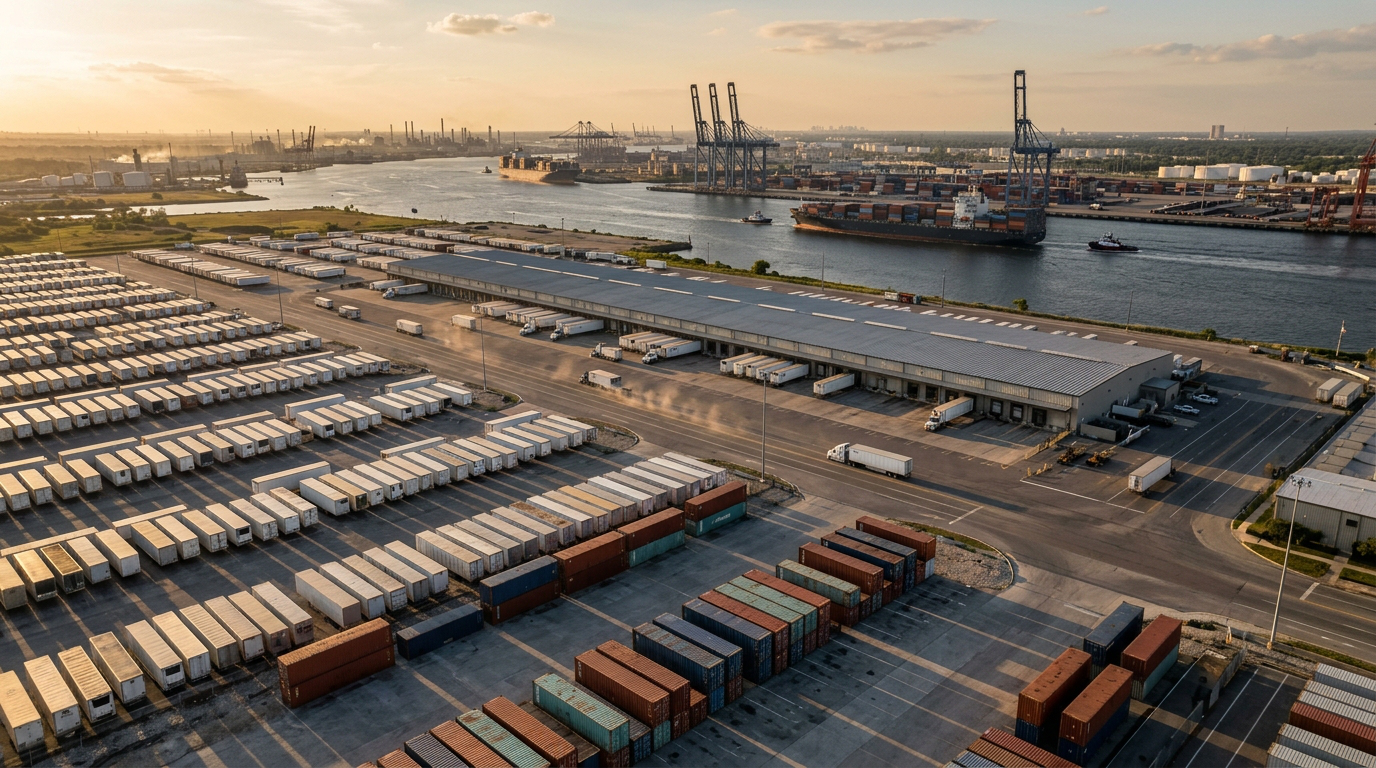
A few miles from some of those half-empty distribution centers, along the Houston Ship Channel, vacancy on industrial outdoor storage sat at roughly 3.4%, and rents had grown 83% over five years.
Same metro. Frequently the same tenants. Radically different outcome.
The difference was the building — specifically, the absence of one.
On May 6, 2026, Brookfield Asset Management completed its $1.2 billion all-cash take-private of Peakstone Realty Trust at $21.00 per share, a 34% premium to Peakstone's pre-announcement close and as much as 51% over recent volume-weighted averages. Of the 76 properties Brookfield acquired, 60 were industrial outdoor storage. That transaction is the clearest signal yet that a fragmented, unglamorous, historically mom-and-pop asset class has arrived at its institutional moment.
Here's what sophisticated capital sees — and why the window to enter on favorable terms is narrowing.
Industrial outdoor storage (IOS) is exactly what the name suggests: secured, improved, industrially zoned land where the revenue-generating asset is the yard, not a structure. Think truck and trailer terminals, container and chassis depots, equipment and fleet staging, construction materials yards, and heavy-haul parking.
Buildings, when they exist at all, are incidental — a small office, a maintenance bay, a cross-dock with drive-in doors. Site coverage from vertical improvements is typically under 15%. The tenant is paying for dirt, access, pavement, drainage, fencing, lighting, and proximity to freight infrastructure.
For decades this was a cottage industry. Owner-users and local operators held the parcels, leases ran two to three years on handshake terms, and the institutional world largely ignored it because deal sizes were too small and data too thin to underwrite at scale.
That era is over. IOS now represents an addressable market estimated at roughly $214 billion — Clarion places it closer to $218 billion for 2026, up from about $200 billion in 2025, growth of nearly 9% in a single year.
This is the single most important thing to understand about IOS, and it's what separates it structurally from every other industrial format.
When warehouse rents spike, developers build warehouses. Capital floods in, cranes go up, and 24 to 36 months later the rent premium is competed away — precisely the cycle that produced Houston's 7.3% big-box vacancy in 2026.
IOS cannot respond that way, because the binding constraint isn't construction cost or capital availability. It's zoning.
Municipal zoning restricts IOS as a by-right use on an estimated 30% to 50% of industrial-zoned land in major metros. Entitlement timelines run 9 to 18 months, extending past 24 months in restrictive jurisdictions.
Cities actively resist IOS. The objections are consistent: truck traffic, lower assessed value per acre than a vertical building, minimal on-site job creation, and straightforward neighborhood opposition. Many municipalities have gone further, prohibiting outdoor storage in new industrial parks entirely and pushing existing yards into legal non-conforming or amortization status.
The result is an asset class where new supply grows at less than 2% annually and the national development pipeline represents just 3% to 5% of existing inventory. Every warehouse built on a former truck yard permanently removes IOS supply. The inventory is not just constrained — in many infill submarkets it is actively shrinking.
You cannot manufacture more of this. That is the whole thesis.
A warehouse is a depreciating asset that consumes capital: roofs, HVAC, dock equipment, sprinklers, tenant improvements, and leasing commissions that can run into the tens of dollars per square foot on turnover.
A gravel or asphalt yard has none of that. Maintenance is grading, striping, fence repair, and periodic resurfacing. Tenant improvements are frequently zero. Re-tenanting is fast, because the next trucking company doesn't need the yard reconfigured — it just needs the gate code.
For family offices and private equity sponsors modeling levered returns, this changes the arithmetic materially. Net operating income converts to distributable cash at a far higher rate than in traditional industrial. Where a warehouse might lose 15% to 25% of NOI to capital reserves and leasing costs over a hold period, a well-improved IOS site loses a fraction of that. The land component — 40% to 60% of total project cost in primary markets — doesn't depreciate at all.
IOS demand is not an e-commerce story, which matters given how much last-mile warehouse underwriting has been repriced since 2022.
Construction and building materials account for roughly 20% to 25% of demand. Logistics and trucking account for another 20% to 25%. The balance spans utilities, energy services, municipal fleets, equipment rental, auto and RV storage, and modular construction. These are operationally captive tenants — a trucking company cannot relocate its terminal 30 miles inland without destroying its driver economics and service radius.
That captivity shows up directly in renewal behavior and pricing power.
The historical knock on IOS was lease quality. That objection is being retired in real time.
| Metric | 2022–2023 | 2026 |
|---|---|---|
| Typical lease term | 2–3 years | 4–6 years |
| Weighted average lease term (WALT) | ~2.5 years | 4.5+ years |
| Annual escalations | Ad hoc | 3–4% standard |
| Build-to-suit commitments | Rare | 7–10 years |
Longer WALTs with contractual escalations are what make an asset financeable, securitizable, and ultimately ownable by core capital. This maturation is the mechanism by which cap rates compress — and it is happening now.
Cap rates. Stabilized IOS trades at 6.00% to 6.75% in primary markets and 6.75% to 7.75% in secondary markets — a premium of roughly 25 to 75 basis points over comparable traditional industrial. Top-tier markets saw 25 to 50 basis points of compression over the trailing twelve months.
Be skeptical of the 12% to 15% "IOS cap rates" circulating in retail-oriented content. Those figures describe unstabilized, unentitled, or operationally intensive situations, not institutional-quality stabilized yards. Real IOS cap rates are tight, and getting tighter.
Vacancy. Primary markets run 4% to 6%; secondary markets 6% to 8%. Fully improved, well-located sites in top metros are frequently below 3% — and in the most supply-starved port-adjacent corridors, functionally zero.
Rent growth. Approximately 8% to 10% in 2024, 7% to 9% in 2025, and a projected 6% to 8% in 2026 — a three-year CAGR near 8% to 9%. Primary market rents run $5,000 to $15,000 per usable acre per month; secondary markets $3,000 to $6,000.
Development economics. Untrended yields on cost of 7.5% to 9.5% in primary markets and 8.5% to 10.5% in secondary, against replacement costs of $250,000 to $400,000 per usable acre. Lease-up typically completes in 6 to 12 months.
Debt. Lenders are treating IOS as a mainstream food group. Loan-to-value ratios of 55% to 65%, debt yields of 9% to 11%, and spreads as low as 165 basis points over SOFR for core assets — 250 to 275 for value-add. Alterra IOS alone has drawn $469 million in debt from Blackstone Real Estate Debt Strategies since 2025, plus $103 million from PGIM and a $400 million refinancing from Truist and KeyBank.
Volume and ownership. Transaction volume reached an estimated $14 billion to $16 billion in 2025, up 15% to 20% year over year. Institutional capital now drives 35% to 45% of acquisitions, up from 25% to 30% four years ago. J.P. Morgan and Zenith formed a $1.5 billion IOS joint venture. Alterra has raised over $1.8 billion across its discretionary ventures.
And yet — critically — private operators and owner-users still hold 65% to 75% of the inventory.
That last statistic is the opportunity.
If you want to see the IOS thesis in its purest form, look at the Houston Ship Channel.
Three conditions have to converge for IOS scarcity to be genuinely structural: concentrated freight demand, high zoning friction, and replacement supply that is difficult or impossible to create. Houston's channel corridor is one of a handful of American submarkets — alongside the Inland Empire, the San Pedro Bay corridor, northern New Jersey's port orbit, and Savannah's port belt — where all three are present simultaneously.
The demand is real and growing. Port Houston handled 4,303,345 TEUs in 2025, a 4% increase and an all-time record. The first half of 2026 set another record at 2.22 million TEUs. Ship Channel tonnage rose 12% in the first quarter of 2026. Every container, every barge, every petrochemical project requires staging land within a viable drayage radius.
The supply is effectively fixed. Fewer than five large rail-served tracts remain available near the Ship Channel. Replacement cost in the channel core — La Porte, Deer Park, Pasadena, Galena Park — exceeds $300,000 per acre, and select parcels have tripled to north of $1 million per acre. Between petrochemical expansion, terminal operations, and residential encroachment, new IOS entitlement in the corridor is functionally impossible.
The performance gap is measurable. Channel-area IOS vacancy of roughly 3.4% with 83% five-year rent growth, against a metro big-box market at 7.3% vacancy posting its first negative annual rent growth in over a decade. Houston-area IOS yards have quoted around $5,500 per acre per month.
The Houston story is not that industrial real estate is strong. Houston's warehouse market is visibly softening. The story is that land-based industrial and building-based industrial have decoupled, and the corridor makes that decoupling impossible to miss.
Pricing has followed. A national truck terminal portfolio traded in February 2026 for $49.5 million — 10 properties, 45 usable acres, 445 drive-in doors, and more than 238,000 square feet of ancillary warehouse. Buyers are paying for gates, doors, and dirt.
IOS is not a passive allocation. The asset class rewards diligence with asymmetric returns and punishes shortcuts severely. Four failure modes account for most impairments.
Environmental liability. IOS parcels are disproportionately former industrial sites — rail yards, fuel depots, salvage operations. Contamination is a live and recurring risk. Unlike a warehouse where an issue may be localized, yard contamination can affect the entire site, eliminating operational flexibility and blocking financing. Phase I is table stakes; when historical use suggests exposure, Phase II is mandatory. Never let a seller's timeline compress this.
Legal non-conforming status. Substantial IOS income sits on grandfathered use rights. You must know precisely what triggers forfeiture — a vacancy period, a change in tenant use, a casualty event, a coverage threshold. In some jurisdictions a six-month vacancy permanently extinguishes the right to operate. That is not a leasing risk; it is a total-value risk.
Unpermitted use creep. Yards attract activity that exceeds the entitlement: prohibited materials, stacking above permitted heights, coverage beyond approved limits. Underwriting income generated by non-compliant operations means underwriting income that code enforcement can eliminate.
Tenant concentration. Many yards run on a single operator. Where one tenant represents the majority of income and the improvements are use-specific, "low capital intensity" becomes cold comfort during a re-tenanting.
Add to that the plain risk of entering a hot market at peak pricing. Cap rates have compressed 25 to 50 basis points in twelve months. Discipline on basis matters more now than it did in 2023.
Brookfield did not pay a 34% premium and fold 60 yards into a global logistics platform spanning 160 million square feet across 19 countries because IOS is a clever trade. It did so because IOS is scarce, cash-generative infrastructure with structurally constrained supply — and because the window to assemble scale before the sector fully reprices is closing.
But the aggregation opportunity remains genuinely open, and the reason is arithmetic. With 65% to 75% of inventory still in private and owner-user hands, and with institutional platforms concentrating on portfolio-scale transactions, the single-asset and small-portfolio market remains materially less efficient than institutional industrial. Deals in the $3 million to $25 million range — too small for Brookfield, too complex for passive buyers — are where private capital still gets paid for diligence.
For high-net-worth investors, family offices, and private equity sponsors, three implications follow:
Basis beats yield. In a compressing cap rate environment with 6% to 8% rent growth, your entry basis per usable acre relative to replacement cost is the variable that determines outcomes. Buying at $180,000 per acre where replacement is $300,000 gives you a margin of safety no pro forma can manufacture.
Entitlement quality is the asset. Two yards a mile apart with identical improvements can differ 40% in value based on by-right status versus non-conforming status. Pay for clean entitlements. Underwrite the zoning ordinance as carefully as the rent roll.
Geography should be chosen structurally, not opportunistically. Target the submarkets where freight concentration, zoning friction, and replacement impossibility genuinely converge. The Houston Ship Channel corridor is the clearest domestic example — and the shrinking number of remaining tracts means that window is measured in quarters, not years.
The $214 billion asset class isn't hiding anymore. Brookfield just told the entire market where it is.
SMART Investments sources, underwrites, and structures industrial outdoor storage and land-based industrial opportunities for high-net-worth individuals, family offices, and private equity partners — with particular depth in the Houston Ship Channel and Gulf Coast logistics corridor.
If you're evaluating an allocation to IOS, or want a second opinion on a yard already under contract, we'll walk you through the entitlement, environmental, and basis analysis that determines whether a deal is institutional-quality or an expensive lesson.
Schedule a confidential consultation to review current IOS and industrial land opportunities, or request our Houston Ship Channel submarket briefing.